
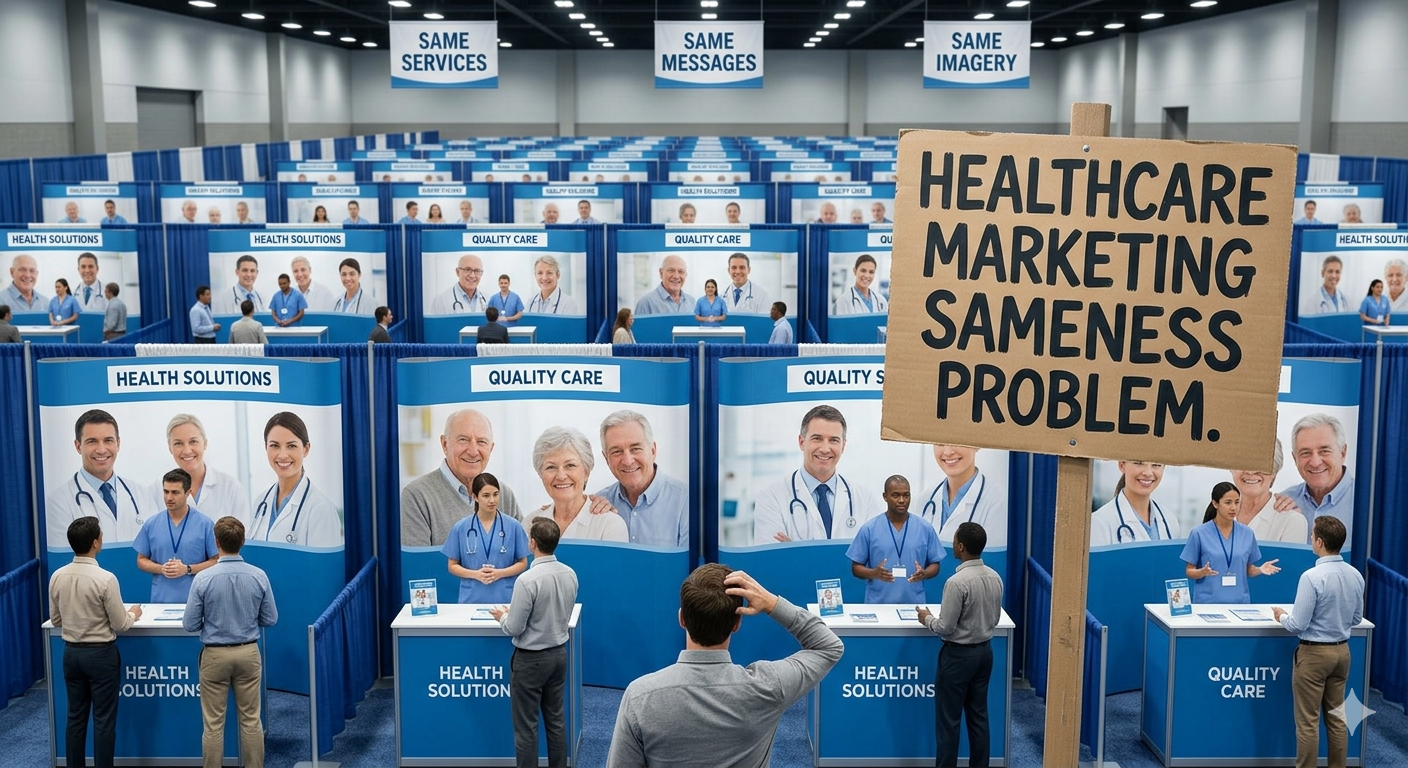
Healthcare marketing often fades into the background because most health systems are designed to protect consensus, minimize risk, and follow category norms instead of leaning into clear, distinctive positioning. The brands that truly break through are the ones brave enough to move beyond safe phrases like “compassionate care” and “patients first,” and instead earn trust through concrete proof, focused strategy, and human, unvarnished stories.
The “everything looks the same” problem
If you walk through an airport, scroll social media, or watch local TV in almost any U.S. market, you’ll notice the same formula playing over and over again. Soft, emotional music. Doctors in white coats walking through spotless hallways. A grateful patient gazing thoughtfully out a sunlit window. A reassuring voiceover promising “innovation,” “compassion,” and “patient-centered care.” The logo changes at the end, but the message rarely does.
This repetitive formula is exactly why most healthcare marketing looks the same. Organizations often rely on the same imagery, language, and emotional cues because they feel safe and familiar. The result is a sea of nearly identical campaigns that struggle to create a memorable impression or communicate what truly makes one healthcare provider different from another.
This is how healthcare ends up with a “sea of sameness.” Organizations use the same visual tropes, the same emotional beats, and the same buzzwords. In a category that should be defined by trust and human connection, many brands unintentionally tell the same story in the same way, making it difficult for patients to remember who said what—or why they should care.
So the real issue isn’t whether healthcare marketing looks and sounds alike. It clearly does. The better question is: what’s driving that pattern?
Four reasons healthcare marketing keeps converging
The root cause usually isn’t a lack of creativity. Most healthcare marketers have strong ideas. They’re just working in systems that quietly reward blending in instead of standing out.
1. Decisions are made by committee
In many health systems, there is no single owner of the brand voice. Campaigns are shaped by clinical leaders, service line owners, legal, compliance, and executives. Each group brings legitimate concerns. But as feedback layers in, anything that feels too bold, too emotionally honest, or too differentiated is often softened or removed. What makes it to the finish line is the safest, most agreeable version of the original idea.
On the client side, the work that moved brands forward was often the work that pushed past what was originally requested—the concepts that agencies brought as their true recommendation to hit the goal, not just the “asks” written in the brief.
2. High stakes amplify fear of being wrong
Healthcare isn’t selling snacks. Messaging touches people’s fears, hopes, and sometimes life-altering decisions. That weight naturally increases risk aversion. When the priority becomes “never offend, never misstep,” the easiest path is to say what everyone else is already saying—and stop there.
3. Benchmarking turns into an echo chamber
Health systems watch each other constantly. When one launches a cinematic patient-story campaign, others follow. When another leans hard into “advanced technology” and “innovation,” that language quickly shows up across the market. Over time, benchmarking stops being a way to learn and becomes a loop where everyone reinforces the same conventions.
4. Complex service lines drive vague umbrellas
A health system is not a single product. It’s cardiology, oncology, orthopedics, primary care, maternity, urgent care, and more—each with its own agenda. When leaders try to unify everything under one message, they often land on a broad, bland promise that offends no one and excites no one. Those broad promises tend to sound exactly like what every other system is saying.
A different way to show up (and why it worked)
In my client-side years leading advertising for a large health system, we faced the same fork in the road. We could have stuck with the standard playbook—beautiful footage, dramatic music, familiar language about quality and compassion. Instead, we chose to hand the microphone to patients and let them tell their own stories.
These weren’t scripted testimonials or corporate soundbites. They were real people talking plainly about what they went through and what their care truly meant to them. The format was still testimonial, but the execution was radically different: more intimate, less polished, less reliant on category jargon.
Patients didn’t say “world-class care” or “cutting-edge innovation.” They talked about fear, relief, being listened to, and the specific moments when someone showed up for them. The work stood out because it was grounded in concrete, human detail; it didn’t feel like it could belong to any other system in town.
That’s exactly why authentic storytelling is so powerful: when a brand uses real narrative with genuine emotion, people remember it in ways they just don’t remember abstract claims.
The hidden cost of “safe” healthcare marketing
Playing it safe can feel responsible in the short term. Over time, it becomes costly.
Patients can’t tell brands apart
If every organization promises “high-quality, compassionate care,” the words lose their force. Patients end up deciding based on proximity, referrals, insurance coverage, or a friend’s experience—not because your brand made a distinct, memorable case for itself.
Media spend outpaces impact
When your creative looks and sounds like everyone else’s, even large budgets struggle to gain traction. You may achieve reach, but you don’t earn meaningful attention or recall.
Trust becomes a commodity
Trust is central in healthcare, but it isn’t built through interchangeable language. Real trust grows from specificity, credibility, and consistent delivery. When your message is generic, whatever trust exists tends to live in “the healthcare system” as a vague idea instead of your brand as a chosen, preferred partner.
Four non‑negotiables for real differentiation
Escaping the sea of sameness isn’t about shouting louder or adding more drama. It’s about making sharper choices and backing them up operationally.
1. Decide what you are not
Many health systems try to be everything: cutting-edge and cozy, massive and hyper-local, deeply specialized and broad access. True differentiation demands tradeoffs. You have to decide what you want to be known for—and be willing to let go of the rest. A clear “lighthouse” identity gives both patients and employees a simple answer to “why us?”
2. Root your brand in something patients can feel
Patients don’t experience your brand in your positioning deck. They experience it when they try to schedule, sit in a waiting room, hear a diagnosis, or get a follow-up call. Your promise becomes powerful when it maps directly to something they can actually feel in those moments—speed, empathy, transparency, coordination, clarity, or another real advantage you deliver consistently.
3. Align the experience, not just the advertising
No amount of clever messaging can cover for a disjointed experience. If your campaign promises one thing and the reality delivers another, trust erodes quickly. Differentiation has to live in your operations: how people are trained, how systems are built, how processes are designed. Marketing should be a reflection of that reality, not a substitute for it.
4. Accept that distinct work feels uncomfortable
If your marketing feels completely comfortable to every internal stakeholder, it’s probably invisible to the outside world. The ideas that genuinely break category norms almost always feel a bit risky at first. That discomfort is often a sign you’re finally saying something real and different.
A more honest way forward
Healthcare doesn’t need more copy that could belong to any brand on the highway. It needs more clarity—clarity about who you are, who you are best equipped to serve, and why a patient would consciously choose you over the nearly identical option down the street.
The goal isn’t to repeat the same promises with a larger budget. It’s to claim a position only you can credibly own—and to prove it every day in the experiences you deliver. In a category where so much communication blends together, the brands that win won’t simply be the loudest or the largest. They’ll be the ones patients can finally tell apart and feel good about trusting.
About The LOOMIS Agency
The LOOMIS Agency is the original challenger brand agency, dedicated to helping underdogs find their voice, blaze new trails, and win in competitive markets. With a proven track record of delivering expertly executed communications programs, LOOMIS helps healthcare and other challenger brands stand out and succeed.
About The Author
